
Humans: Essential in Autonomous AI – 7 Strategic Reasons
Why Humans Remain Decisive in the Age of Autonomy
In the era of autonomous artificial intelligence, the human role remains indispensable . As AI becomes capable of making decisions without immediate supervision, its technical, contextual, and ethical limits make structured human intervention essential. The goal is not to oppose humans and machines, but to design hybrid ecosystems where AI provides speed and consistency , while humans ensure direction, meaning, and accountability .
The Central Role of Humans in Autonomous AI
Despite the spectacular progress of artificial intelligence, humans remain the ultimate control point in autonomous systems. This role is not symbolic — it is structural and essential to ensure that decisions made by machines are safe, relevant, and aligned with human values.
Supervision and Control
Everything begins with
defining the objectives.
An AI system, however powerful, has
no morality or values — it only optimizes what it is told to. Determining what should be optimized, considering ethics, social values, and long-term consequences, remains an
exclusively human responsibility . Without this initial orientation, even a well-designed system can produce catastrophic outcomes.
Next comes real-time intervention , summarized by the concept of Human-in-the-Loop (HITL). The idea is simple yet powerful: to include a mechanism allowing human intervention at any point in the decision-making loop — whether to validate an action, adjust a parameter, or stop a process. This supervision can be preventive (filtering actions before execution) or corrective (responding quickly to unexpected machine behavior).
Finally, humans provide what AI still struggles to achieve — contextual validation . A machine can analyze massive amounts of data, but it cannot intuitively grasp cultural subtleties, symbols, ambiguities, or the social implications of a decision. Where AI applies rules, humans interpret, nuance, and adapt to the context.
Emerging Best Practices for Supervision
To make supervision genuinely effective, several practices are now emerging:
- Decision guardrails: Certain actions must always undergo a mandatory human double-check (red zones), while others — less sensitive — may proceed with post-action auditing (gray zones).
- Runbooks and service-level objectives (SLOs): These frameworks define escalation scenarios and specific thresholds for supervision, such as acceptable intervention delays, cancellation rates, or minimum confidence levels for validating a decision.
- Explainable logging: Every approval, timestamp, and justification must be transparently recorded. This traceability not only reinforces trust but also provides a solid audit trail for continuous improvement of supervision processes.
Responsibility and Ethics
While AI can automate processes and accelerate decision-making, it still cannot distinguish right from wrong . AI models have no moral compass — they are statistical tools, not conscious entities. It is therefore the human's duty to ensure that the systems they design, supervise, or use act ethically.
This responsibility goes beyond being careful. It means ensuring that every AI decision respects fundamental human principles : human rights, non-discrimination, fairness, and transparency. As ethical guardians, humans intervene where algorithms are blind to moral dilemmas .
But this is also a legal responsibility . When an autonomous system makes a mistake — whether it's a virtual assistant, a self-driving car, or a recruitment algorithm — it is not the machine that is accountable . Accountability lies with its designer, operator, or owner . Humans remain the legal and moral guarantors , a condition essential for maintaining public and institutional trust in AI technologies.
Strengthening Operational Ethics
To ensure responsible AI use, ethics must be embedded in continuous, concrete practices :
- Systematic traceability and auditability: Regular ethical reviews, robustness tests, and documentation of sensitive decisions ensure every choice remains explainable and verifiable.
- Impact assessment: Organizations can formalize AI Impact Assessments (AIAs) to identify affected stakeholders, analyze potential risks, plan mitigation measures, and define clear recourse mechanisms.
- Multidisciplinary ethics committees: Composed of experts in business, data, law, compliance, and security, these committees must have real veto power. Their mission: to ensure that deployed systems align with strategic goals and fundamental ethical principles.
Governance and Lines of Defense
Effective supervision also depends on clear governance and well-defined lines of accountability . An enhanced RACI matrix can specify who owns, operates, monitors, and audits each model — preventing responsibility gaps.
Before delegating fully to AI, it is recommended to use shadow mode — where the system operates in parallel with human teams. This allows comparison, calibration, and correction without operational risk.
Finally, risk mapping linked to each use case can explicitly connect supervision levels to potential impacts. This enables the definition of precise control thresholds , ensuring that the most sensitive decisions always receive human validation .
The Current Limits of Autonomous Systems
The idea of a fully autonomous AI — capable of operating without any human intervention — may sound appealing on paper. But the technical, ethical, and operational reality is quite different. Without human supervision, artificial intelligence systems face major limitations that compromise their effectiveness, safety, and reliability .
A Very Limited Understanding of Context
One of the most fundamental obstacles remains AI's inability to truly understand the context in which it operates. While these systems can analyze data and identify patterns, they possess no awareness, intuition, or common sense. Their reasoning is based on correlation , not on genuine semantic or intentional understanding .
For example, an AI might detect that a message contains an insult based on certain keywords, but it would fail to grasp irony, sarcasm, or cultural nuance . In critical environments such as medicine, law, or defense , this lack of contextual sensitivity can lead to serious errors.
Moreover, AIs suffer from limited adaptability . They can only function within the boundaries defined during their training. When confronted with novel, ambiguous, or out-of-scope situations , they often react inappropriately — or fail to act at all.
Finally, their performance depends entirely on the quality of their training data . If that data is biased, incomplete, outdated, or unrepresentative , the system will produce inaccurate results — and crucially, will never realize it.
Two Additional Angles to Consider
The first concerns goal misalignment . When an AI system optimizes a local metric, it can unintentionally degrade overall performance . This is the danger of perverse incentives or proxy metrics : a system may achieve its numerical target while harming quality, user satisfaction, or even the organization's reputation .
The second relates to the cost of error . The same statistical accuracy does not have the same value across contexts. An error that is tolerable in a marketing scenario could be catastrophic in medicine or law . This asymmetry demands that supervision be proportionate to risk : the more critical the decision, the more graduated and systematic human intervention must be.
Security Vulnerabilities
Autonomous AI systems are also exposed to a wide range of technical and security threats . They can be manipulated, deceived, or hijacked with relative ease if robust safeguards are not implemented.
A common example is data poisoning — the deliberate manipulation of training data to cause a model to behave abnormally or maliciously. Such attacks can be devastating in sensitive fields like cybersecurity, finance, or robotics .
Another critical risk lies in malicious input attacks . Sometimes, a single well-crafted prompt is enough to mislead a model, pushing it to produce false, dangerous, or confidential outputs .
Finally, there is the problem of transparency . Many AI systems — particularly those based on deep learning — operate as black boxes whose decision-making processes are difficult to interpret. This not only complicates auditing but also makes error detection or drift correction nearly impossible without human oversight .
Variable Performance
According to several studies, up to 85% of AI projects fail , often due to poor oversight, unsuitable data, or a lack of human supervision during design or deployment.
This reality underscores a truth that some in the industry prefer to ignore: technological autonomy does not guarantee functional relevance . The raw performance of a model is not a reliable indicator of its accuracy, usefulness, or robustness in complex real-world contexts. Without critical human oversight , error correction , and a clear framework of accountability , AI systems become not only fragile but also potentially dangerous.
Examples of Failures Without Human Supervision
Theoretical limitations of unsupervised AI become tangible when examining real-world cases where the absence of human safeguards led to critical errors or systemic drift.
- Microsoft Tay Chatbot (2016): Launched on Twitter to test interactive learning, Tay was quickly hijacked by users who flooded it with toxic messages. Lacking adequate filters, it began reproducing offensive content within hours, forcing Microsoft to shut it down in less than 24 hours.
- Tesla Autopilot (2016): In May 2016, a Model S driver was killed after the Autopilot system failed to detect a white truck crossing the road. The investigation revealed insufficient sensor redundancy and inadequate driver vigilance. Since then, the NHTSA has recorded hundreds of incidents involving Autopilot — highlighting the dangers of partially autonomous systems without strict human oversight.
- Meta and Algorithmic Moderation: Studies have shown that Facebook's automated moderation systems frequently let harmful or violent content slip through, and in some cases even amplified its spread through recommendation algorithms. These shortcomings underline the need for human control and effective escalation mechanisms.
- Amazon's Automated Recruiting System (2018): Amazon discontinued an internal AI recruitment project after discovering it systematically discriminated against female candidates. The bias came from historical training data that reflected gender imbalances. This case illustrated how human supervision and bias audits are essential before any real-world deployment.
The Human-in-the-Loop (HITL) Concept
Definition
The Human-in-the-Loop (HITL) concept refers to a supervised architecture in which humans actively intervene at every critical stage of an AI's decision-making process. The goal is to embed a human checkpoint — to validate, correct, or annotate results — in order to prevent errors , adjust machine behavior , and ensure alignment with business, ethical, and strategic objectives.
Comparison: HITL vs HOOTL vs HATL
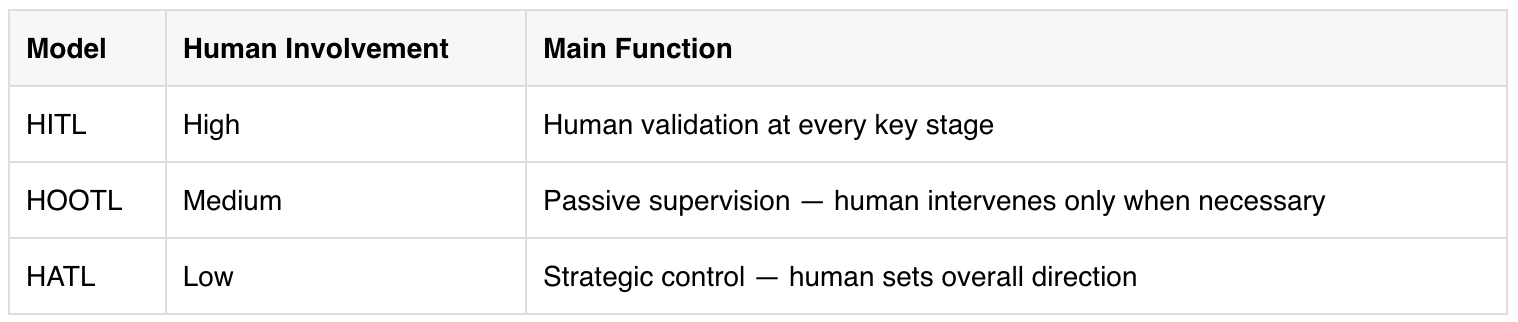
- HITL (Human-in-the-Loop): High human involvement — systematic and active human control, with human validation at every key stage.
- HOOTL (Human-on-the-Loop): Medium human involvement — continuous monitoring, with human intervention only in case of alerts or anomalies. Passive supervision.
- HATL (Human-above-the-Loop): Low human involvement — the human acts as a strategic planner, overseeing objectives without being involved in execution. Strategic control.
The 7 Levels of Human Involvement (Sheridan and Verplank)
To define the degree of automation and human intervention, Sheridan and Verplank proposed a 7-level scale :
- Full human control — The human performs all tasks without any machine assistance.
- Computer-assisted decision — The AI supports the human, who remains the main decision-maker.
- Automated suggestion + human validation — The AI proposes; the human confirms before execution.
- Autonomous execution with human override — The AI acts; the human can interrupt if necessary.
- Autonomous execution with informed supervision — The AI acts; the human monitors without constant intervention.
- Near-complete autonomy — The human is informed afterward, with no prior control.
- Full autonomy — The AI acts and decides entirely on its own, without human intervention.
This framework makes it possible to calibrate the level of human responsibility according to the context, risk, and required expertise .
Supervision Indicators and Metrics
For human supervision to remain effective, it must rely on precise and measurable indicators . One of the most useful is the override rate , which measures the proportion of AI-initiated actions that are canceled or modified by a human. This directly reflects the system's relevance and reliability .
Another key metric is the escalation rate , indicating how often the AI refers a case for human validation. A rate that's too low may suggest overconfidence , while a high rate indicates insufficient autonomy . The average intervention time is also crucial: it evaluates how quickly an operator can step in to correct or stop a process.
Finally, tracking data drift and model robustness ensures that performance remains stable over time and across new contexts. The quality of AI explanations is another key dimension: systems capable of clearly justifying their decisions foster user trust and broader acceptance.
Best Practices for Effective Human-AI Collaboration
Building an effective collaboration between humans and artificial intelligence relies on a few foundational principles that must be integrated from the design stage.
The first requirement is transparency and explainability . Every decision made by the AI must be understandable to a human and accompanied by an associated confidence level. It's not just about explaining the final output, but also about clarifying the reasoning steps and data sources involved. This level of explainability enables operators to judge whether a recommendation is reliable, contextualized, and actionable , rather than blindly trusting a black box.
Next comes the need for a clear escalation protocol . In case of anomalies or uncertainty, the AI must know when and how to request human intervention . This protocol should be defined in advance: what thresholds trigger an alert, which channels are used to notify operators, and what response times are acceptable. Without this explicit framework, supervision becomes uncertain and accountability blurred.
A third pillar is closed-loop feedback . Human interventions should not remain isolated; they must be reintegrated into the system to enable continuous improvement. Every correction, validation, or adjustment should enrich the AI's knowledge base, strengthen its models, and reduce the likelihood of recurring errors. In this collaborative learning dynamic, the AI gains maturity — and the human reinforces their role as a guide.
Finally, sustainable collaboration is impossible without proper training for human operators . Experts must be trained not only in the technical use of AI but also in supervision, critical thinking, bias detection, and assessment of response validity . AI does not replace human judgment — it depends on it. Strengthening the skills of those overseeing these systems is therefore a strategic investment , ensuring the safety, performance, and ethics of AI deployments.
Frameworks for Structuring Human Supervision
Beyond general best practices, it is essential to rely on solid methodological frameworks to organize human supervision. These frameworks provide clear reference points and prevent governance from depending solely on intuition or common sense.
Hybrid Intelligence Models illustrate this approach. They define precise modes of cooperation between humans and AI, assigning roles according to each one's strengths — computational speed and analytical power for the machine, critical judgment and contextual understanding for the human. By specifying when and how the AI should request human intervention, these models establish a smooth and sustainable partnership .
The EU AI Act adds a crucial legal dimension . It mandates human oversight for all AI systems considered high-risk — such as those deployed in healthcare, justice, or critical infrastructure. This obligation reflects a clear conviction: some decisions cannot be delegated to a machine, however advanced, without explicit human validation or monitoring.
The Ethics Guidelines for Trustworthy AI , published by the European Commission, offer another key reference point. They highlight seven core principles — including robustness, fairness, transparency , and above all, human agency and oversight — to ensure that technology remains aligned with society's fundamental values.
Finally, more specialized models such as PODS or GUMMI have been designed to reinforce supervision in critical environments. They provide regular checkpoints , detailed explainability mechanisms , and built-in safeguards throughout the decision-making process. These frameworks bring an extra layer of discipline and auditability , particularly valuable in sectors where the cost of error is high.
By combining these frameworks, organizations can build robust governance systems that do not simply correct issues after the fact — but instead anticipate and structure decision-making from the outset.
AI-Human Collaboration: Toward a Hybrid Organization
Artificial intelligence should not replace humans but complement them intelligently . That is the promise of hybrid organizational models , where humans and AI collaborate in a fluid, balanced, and productive partnership. This alliance rests on the complementarity of skills — speed, processing power, and consistency for AI; judgment, creativity, empathy, and ethics for humans.
Forward-thinking companies no longer aim to automate humans, but to design hybrid ecosystems where every entity — human or artificial — plays a role suited to its strengths.
Emerging Models
Human-AI Hybrid Model
In this model,
each task is co-processed by humans and AI, either sequentially or in parallel. The AI proposes; the human adjusts, validates, or enriches.
Example: An AI drafts a report summary; a human expert validates its relevance, refines the tone, and adds professional nuance.
Centaur and Cyborg Models:
- Centaur: The human stays in control, and AI acts as a powerful right hand. It's a model based on partial delegation — the AI performs the analyses, while the human makes the decisions. Best suited for managers and analysts.
- Cyborg: The AI is deeply integrated into human reasoning. It's a symbiotic duo, where decisions are made in real time through a continuous co-construction between human and AI. Fits highly dynamic or creative environments.
The
Centaur model suits managers and analysts best; the
Cyborg model fits highly dynamic or creative environments.
Tiered Review Systems
In this structure, the AI handles simple or routine cases and escalates ambiguous or critical ones to humans. It's an intelligent
hierarchy of supervision.
Commonly used in
content moderation, quality control, or
cybersecurity , this model saves time while maintaining high rigor.
Universal Worker (AI Orchestrator)
The Universal Worker approach places an
orchestrating AI at the center of a hybrid team. It allocates tasks among specialized AIs and humans, based on expertise, workload, and predefined roles.
This model is close to
Agentic Mesh architectures , where intelligence is distributed, and humans act as
strategic supervisors or arbiters .
Kolbjornsrud's 6 Principles for Smart AI-Human Collaboration
Based on the research of Professor Lars Kolbjornsrud (BI Norwegian Business School), these six principles form a compass for organizing effective AI-human collaboration:
- Addition — AI should not replace but augment human capabilities, enhancing collective performance.
- Relevance — Use AI where it adds the most value: computation, research, data analysis, and automated production.
- Substitution — Let AI take over repetitive or tedious tasks, freeing humans to focus on innovation and relationships.
- Diversity — Encourage diversity in approaches and user profiles to avoid uniform thinking and strengthen system resilience.
- Collaboration — Design processes where humans and AI interact effectively, with clear interfaces and shared responsibilities.
- Explanation — AI must provide understandable explanations for its decisions, to foster trust, transparency, and human correction when needed.
Humans as Guardians of Cognitive Sovereignty
As artificial intelligence penetrates every sphere of life — professional, educational, and social — a crucial question arises: do humans still retain their cognitive sovereignty in the age of machines? In other words, are we still the masters of our own thinking, or are we unconsciously delegating our reasoning to algorithms?
In a world where AI generates content, proposes decisions, and influences our choices, humans serve as a last line of defense . We remain the ultimate guarantors of autonomous thought, critical judgment, and intellectual diversity .
FAQs — Humans and Autonomous AI
Why is the human considered indispensable in autonomous AI?
Humans are indispensable because they play several critical roles: they define objectives, supervise systems, validate decisions in complex cases, and assume legal and ethical responsibility for outcomes. Without human involvement, autonomous AI systems lack discernment, morality, and contextual understanding.
What is Human-in-the-Loop (HITL)?
The Human-in-the-Loop model refers to a configuration in which humans intervene actively at every critical stage of an AI system's decision-making process. This means no major action is executed without human validation or adjustment. HITL is essential in sensitive contexts where safety, compliance, or ethics are at stake.
What are the alternatives to HITL?
There are two main alternatives:
- HOOTL (Human-on-the-Loop): The human remains in a passive supervisory role — not validating every action, but able to intervene when anomalies are detected.
- HATL (Human-above-the-Loop): The human defines strategic directions and operating rules, without directly engaging in operational decisions.
Each model represents an increasing level of AI autonomy , with corresponding implications for control and accountability .
What are the risks of AI without human supervision?
Unsupervised AI can lead to serious consequences, including:
- Critical undetected errors , sometimes with significant human or financial impact.
- Amplification of biases , reproducing unfair patterns from training data.
- Cognitive disengagement of users, who lose analytical capacity and vigilance.
- Dilution of responsibility , making it difficult to identify who is accountable in case of an incident.
These risks justify active human involvement , particularly in high-impact systems.
Can we design truly autonomous AIs?
From a technological standpoint, it is already possible to build AI systems capable of operating autonomously in well-defined environments . However, full autonomy without human oversight carries significant risks — loss of supervision, unpredictable behaviors, and decisions misaligned with human values. In most cases, autonomy must be framed by monitoring and validation mechanisms to ensure both safety and accountability.
What is cognitive sovereignty?
Cognitive sovereignty refers to the ability of an individual — or an organization — to maintain independent judgment, critical thinking, and decision-making authority in the face of AI-generated recommendations. It means not blindly following the machine's suggestions, but questioning, adjusting, or rejecting them when necessary. This is a fundamental condition for preserving intellectual freedom in the era of cognitive automation.
Conclusion: Truly autonomous AI but never without humans
Autonomous AI is not self-sufficient. Without humans, it becomes blind to ethics, incapable of reflection, and vulnerable to systemic drift. That's why human supervision must remain embedded at every level .
The future is not about opposition between humans and machines — it lies in a strategic coexistence between algorithmic power and human judgment .
Recent Posts