Agentic Mesh: The AI Architecture That Will Revolutionize Collaborative Work

From AI Assistant to Autonomous Digital Team

Artificial intelligence has already transformed the way we work. With conversational assistants like ChatGPT, Copilot, and Gemini, professionals have discovered the power of generative AI to write, summarize, or automate micro-tasks. Yet, as use cases become more complex, these models reveal their limits: powerful, yes — but isolated, one-off, and linear.

This is where a new architecture emerges — quieter but radically more ambitious: the Agentic Mesh. It’s a network of AI agents that work together as a team — communicating, cross-checking, coordinating, and delivering professional-grade results without constant human supervision.

Still relatively unknown to the public, the Agentic Mesh could soon become the technical backbone of AI-assisted work in the years ahead.

What Is an Agentic Mesh? A simple definition and strategic impact

An Agentic Mesh is an architecture in which multiple specialized AI agents cooperate autonomously to achieve a complex goal. It’s no longer a single AI responding to a command, but a distributed digital team — coordinated without human intervention.

From Tool-Based AI to Intelligent Network

A traditional AI tool follows a simple pattern: you give an instruction, you get a response. The interaction is linear, with no collective memory or built-in quality control.

The Agentic Mesh completely changes this logic. Here, several specialized agents operate in parallel: one focuses on information extraction, another on verification, a third on synthesis. Each brings its own expertise — but above all, they collaborate.

These agents hand off tasks, evaluate each other’s work, and are capable of self-correcting throughout the process. This dynamic creates a true distributed reasoning chain, where every step benefits from multiple layers of review. The result is not just a raw output, but a structured, coherent deliverable — immediately usable in a professional context.

In short, the Mesh behaves not like a single tool, but like a cooperative intelligent network, mirroring a well-organized human team — with role specialization, peer review, and a continuous focus on the quality of the output.

How It Works: Roles, Coordination, and Self-Verification

Within a Mesh, agents don’t operate in isolation. Each has a clearly defined specialty and contributes to the overall process much like a member of a human team:

  • One agent searches for information, scanning relevant sources and extracting key data.
  • Another verifies reliability, assessing the accuracy of references, data consistency, and potential bias.
  • A third synthesizes content, structuring information and highlighting key insights.
  • A fourth adapts the deliverable, reformulating it in the required tone or format — whether a strategic memo, scientific report, or presentation deck.

What makes this system unique is the active cooperation between agents. They continuously exchange information, escalate complex issues to more capable peers, and delegate tasks when they reach their limits. This ability to self-organize introduces an unprecedented level of resilience and efficiency.

The result: greater productivity — but above all, greater coherence, quality, and traceability.

Why the Agentic Mesh Is a Game-Changer for Knowledge Work

The Agentic Mesh is not just a technical breakthrough — it’s an organizational response to real-world business challenges. In practice, a valuable mission is never a single task. It requires searching, understanding, verifying, rephrasing, prioritizing, and presenting.

The Mesh reproduces this logic — but at the scale of AI.

Real-World Examples of Complex Missions Executed by a Mesh

The power of an Agentic Mesh isn’t measured by its ability to automate simple actions.It shines in the execution of complex, multi-source missions, precisely where traditional AI reaches its limits.

  • Scientific literature review
    Starting from a corpus of 50 academic sources, the Mesh can analyze, filter, and compare relevant publications. Specialized agents cross-check results, verify citations, and produce a structured synthesis that meets scientific standards — while drastically reducing the time required.
  • R&D tax credit (CIR) documentation
    By combining a patent, a state-of-the-art analysis, and the company’s internal technical documentation, the Mesh generates a complete, auditable R&D tax credit report. The agents — or “Kins” — ensure the accuracy of references, regulatory compliance, and clarity of explanations, greatly facilitating dialogue with tax authorities.
  • Strategic briefing note for an executive board
    The Mesh can consolidate internal reports, sector analyses, and market data to produce a decision-oriented strategic memo. The deliverable highlights opportunities, risks, and potential trade-offs — remaining both clear and actionable for executives.

Across these examples, one principle remains constant: the Mesh doesn’t just assist experts — it acts as a distributed digital team, capable of handling massive information flows, structuring knowledge, and delivering professional-grade outputs.

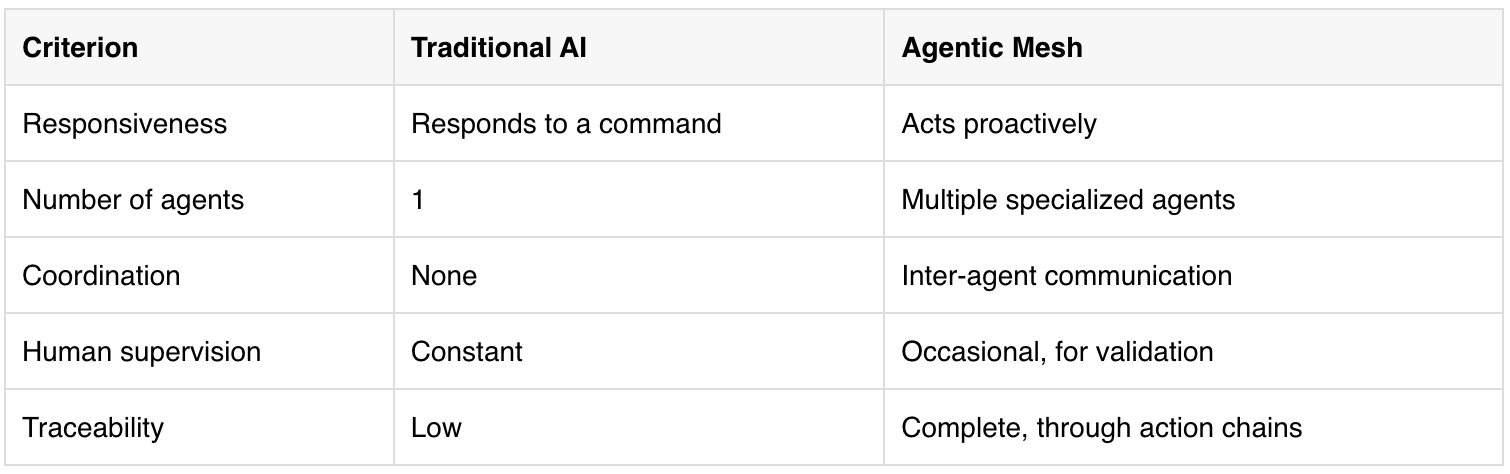
Fundamental Differences from a Traditional AI Assistant

Criterion Traditional AI Agentic Mesh
Responsiveness Responds to a command Acts proactively
Number of agents 1 Multiple specialized agents
Coordination None Inter-agent communication
Human supervision Constant Occasional, for validation
Traceability Low Complete, through action chains

The DigitalKin Approach: AI That Thinks as a Team

At DigitalKin, the choice is deliberate: we don’t rely on generic, interchangeable, and superficial assistants. We design Kins — specialized, autonomous AI agents built to cooperate. Each Kin has a clear mission and a defined role, ensuring higher work quality and results that align precisely with real business needs.

A Multi-Agent Architecture Built Around Deliverables

The Mesh we’ve designed operates on a collaborative and distributed logic. Several Kins can be mobilized simultaneously toward a single goal, each contributing its unique value:

  • One Kin drafts the initial content or synthesis.
  • Another verifies the data, ensuring accuracy and source compliance.
  • A third reformulates the deliverable in the client’s tone, adapting style and vocabulary.
  • A fourth evaluates clarity, coherence, and business relevance.

This collaborative workflow mirrors how a well-structured human team operates: role specialization, peer review, and iterative refinement. The outcome is a deliverable that is more robust, transparent, and strategically aligned with user expectations.

By embracing this approach, DigitalKin transforms the Mesh into a true distributed digital workshop, where AI doesn’t just generate text but creates reliable, contextualized, and actionable value.

Built-In Quality and Control Through the “Kin System”

Within the Mesh, quality is not a post-process check — it’s native to the architecture. The Kin System relies on fractal self-critique loops, allowing each agent to continuously evaluate the relevance of its own output and that of others.

In practice, a Kin can:

  • Detect inconsistencies — whether in data contradictions, deviations from business rules, or stylistic drift.
  • Reassign a task to a better-suited Kin, ensuring that every mission is handled by the most competent agent.
  • Generate an error report, transparently documenting weak points identified and corrections applied.

This approach establishes a distributed, cooperative review process, where every agent becomes not only a producer of value but also an active quality controller.
The result is a more reliable, auditable, and resilient production chain, capable of delivering outputs that meet the strictest professional standards.

Transparency, Traceability, and Business Alignment

One of the Mesh’s key strengths lies in its ability to make every production fully understandable and verifiable. Unlike opaque “black box” AI systems, it embeds mechanisms that ensure clarity and trust at every step.

  • Every deliverable is audited: The final result isn’t a raw output — it’s accompanied by validations and checks ensuring compliance with business and regulatory expectations.
  • Every source is documented: All references used — articles, databases, or internal documents — are explicitly cited and traceable, enabling users to verify the evidence behind any analysis or recommendation.
  • Every step is intelligible to business experts: Intermediate reasoning, decision criteria, and chosen methods are presented clearly, allowing users to understand, question, and refine the AI’s work when needed.

By combining these three dimensions, the Mesh establishes a new standard of transparency, guaranteed traceability, and natural business alignment — creating a foundation of trust between human and machine collaboration.

Agentic Mesh vs. Human Team: Complementarity and Limits

The Agentic Mesh is not designed to replace humans — its purpose is to complement them by handling low–value-added tasks.

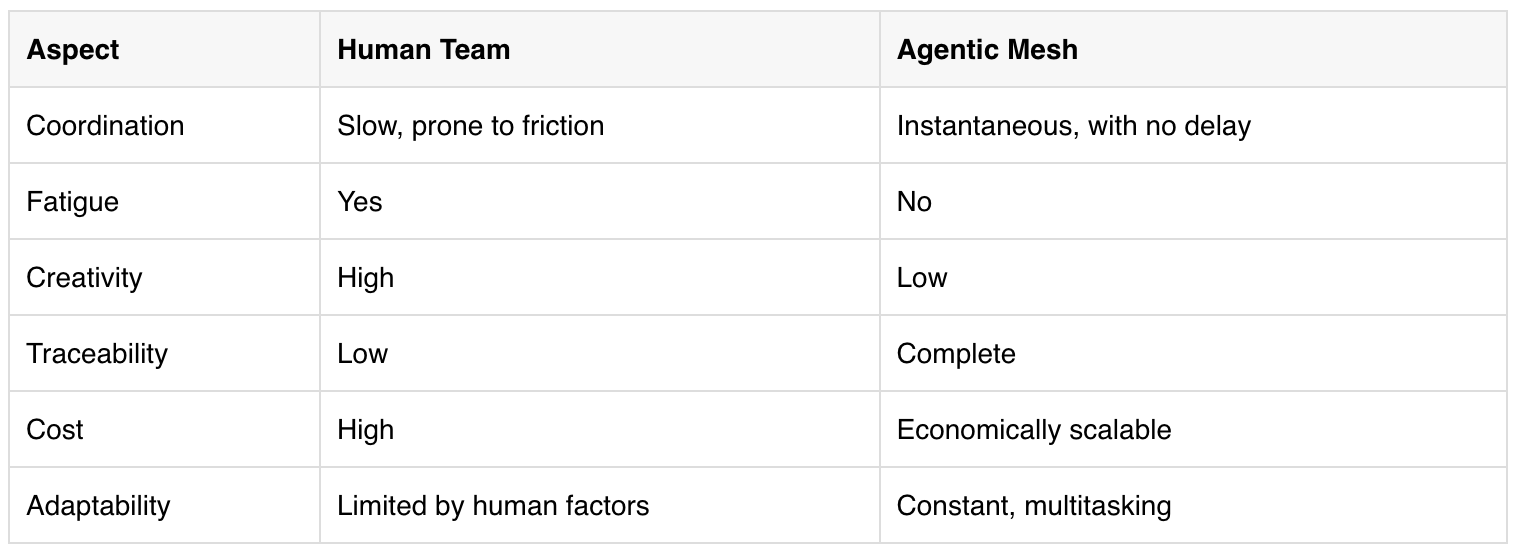
Clear Comparison Between a Human Team and an Agentic Mesh

Aspect Human Team Agentic Mesh
Coordination Slow, prone to friction Instantaneous, with no delay
Fatigue Yes No
Creativity High Low
Traceability Low Complete
Cost High Economically scalable
Adaptability Limited by human factors Constant, multitasking

Tasks to Delegate to the Mesh

The Agentic Mesh excels when handling information-intensive, repetitive activities that require high methodological rigor. Among the missions that can be confidently delegated to its agents are:

  • Document analysis — scanning vast corpora of scientific publications, technical reports, or industry databases. The Mesh identifies relevant information while filtering out noise and redundancy.
  • Production of structured technical content — including executive summaries, regulatory reports, or R&D files. Its ability to organize and format information according to strict standards saves considerable time.
  • Synthesis, benchmarking, and comparative research — by cross-referencing multiple sources to reveal trends, detect discrepancies, and highlight common patterns.
  • Factual review and verification — through cross-checking mechanisms that minimize the risk of errors and strengthen the reliability of produced deliverables.

In short, the Mesh excels in tasks where speed, accuracy, and standardization create direct business value.

Tasks to Keep Human

Conversely, some dimensions are intrinsically human and cannot — or should not — be delegated to AI. They are what give meaning, direction, and humanity to collective work:

  • Strategic decision-making, which requires a holistic understanding of context, long-term vision, and the ability to arbitrate beyond measurable facts.
  • Creativity, design, and storytelling, where originality, sensitivity, and human intuition remain irreplaceable.
  • Client relationship management, built on listening, empathy, and trust — deeply human qualities that no algorithm can replicate.
  • Ethical or political arbitration, since some choices involve values, social responsibility, or societal implications that machines cannot resolve alone.

This defines a clear balance: to the Mesh, analytical and procedural tasks; to humans, meaning, relationship, and creation. It is within this complementarity that the true strength of the augmented enterprise lies.

Current Use Cases of the Mesh in Business

At DigitalKin, the Agentic Mesh is not a futuristic concept — it is already deployed across several strategic sectors, where it is transforming the way research, innovation, and knowledge production are conducted.

Healthcare and Pharmaceuticals

In this field, scientific literature review is often a time-consuming and complex process. The Mesh automates the screening of publications, selecting only those that meet predefined quality and relevance criteria. Beyond filtering, it also performs cross-source consistency checks, comparing results from clinical trials, academic papers, and specialized reviews. The outcome: researchers save considerable time while gaining access to more reliable, better-documented analyses.

Industrial Innovation

In industry, the Agentic Mesh addresses another critical challenge — the exploration and analysis of patents. It can automatically read large patent corpora, compare them to the scientific and technological state of the art, and extract useful insights to guide innovation strategies. This ability is particularly valuable in highly competitive sectors, where the speed and precision of analysis can make all the difference.

The Mesh also streamlines the generation of R&D Tax Credit (CIR) reports. Through a structured and auditable approach, it automates the collection and formatting of required evidence, ensuring both regulatory rigor and productivity gains.

Looking Ahead: Toward an Operating System for Augmented Organizations

The Agentic Mesh does more than enhance existing tools — it lays the groundwork for a new work infrastructure, one that could soon become the true operating system (OS) of the augmented enterprise.

From SaaS to Organic AI

Today’s organizations rely on a multitude of software tools — ERP, CRM, BI platforms, and collaborative systems.Each operates in its own silo, with integrations depending on complex, fragile APIs that are difficult to maintain. This fragmentation hinders agility and accumulates technical debt over time.

With the Agentic Mesh, the paradigm shifts:

  • Agents become the intelligent connectors between systems. Instead of rigid integrations, autonomous entities orchestrate real-time data exchanges.
  • AI interprets objectives, mobilizes the right tools, acts, verifies, and delivers. Humans no longer need to search for features — the software adapts dynamically to the mission.
  • Interaction itself evolves: no more clicking through interfaces to execute commands. Users now express missions — “prepare a competitive analysis,” “structure a regulatory report” — and the Agentic Mesh delegates the task to a digital team of specialized agents.

This transition marks a profound shift — from command-based software to cooperative software; from tools that must be manipulated to digital partners capable of working alongside humans. That is the transformation that will make the Agentic Mesh the invisible yet decisive backbone of the augmented enterprise.

FAQs – Understanding the Agentic Mesh and Its Potential

  1. How is the Agentic Mesh different from an AI assistant?
    An assistant works alone and reacts to commands. The Mesh, on the other hand, brings together multiple agents that cooperate, self-verify, and produce a complete deliverable.
  2. Does the Mesh replace a human team?
    No. It handles repetitive, analytical, or technical tasks but leaves strategy, creativity, and relationship management to humans.
  3. Is it risky to delegate missions to autonomous agents?
    Not if governance is clear. A well-designed Mesh includes safeguards such as traceability, cross-validation, and human supervision.
  4. Can an Agentic Mesh already be deployed in business environments?
    Yes. Architectures like those developed by DigitalKin are already in use across complex industries such as healthcare, finance, and manufacturing.
  5. What are the key advantages?
    Time savings, improved document consistency, fewer errors, enhanced traceability, and scalable intellectual functions.
  6. Do you need to be an AI expert to benefit from it?
    No. The Mesh is built to integrate directly into business contexts, with accessible interfaces and immediately usable deliverables.

Conclusion: The Agentic Mesh as the Foundation of Augmented Work

The Agentic Mesh should not be viewed as a mere technical concept. It represents a profound transformation in the relationship between humans, artificial intelligence, and work. It marks the end of isolated AI tools limited to specific, disconnected tasks — and the beginning of cooperative, distributed, and governable AI.

This type of architecture paves the way for a new generation of organizations capable of:

  • Automating without standardizing, allowing machines to handle operational complexity while preserving the diversity of human approaches and styles.
  • Gaining speed without sacrificing quality, through interactive loops where algorithmic efficiency combines with human judgment and expertise.
  • Scaling human thought without losing originality, amplifying analytical and production capacities while preserving creativity, nuance, and the singularity that define human value.

At DigitalKin, this vision is not a distant future — it is an operational reality already embodied in our solutions. The Agentic Mesh sits at the heart of our approach, empowering companies to combine technological strength with collective intelligence — ensuring that machines remain in service of humanity.Tomorrow, this model will become the standard for all organizations seeking to remain competitive while asserting their cognitive sovereignty and social responsibility.